a new literary
thoughtspace
Literature has trends. For decades, the major publishing houses have relied on fast lit as the backbone of their sales. Consumers love it. We suspect it will continue to be popular with readers far into the future.
Psychological literature, not to be mistaken with psychological thrillers (an entirely different genre), has been around for centuries. Shakespeare's Hamlet is a good example. So are Kazuo Ishiguro's The Remains of the Day, The Great Gatsby, To Kill a Mockingbird, and The Color Purple. Movies like A Star Is Born, Titanic, and even the Barbie movie are examples.
We're definitely not comparing Tate's work to any of these. The point is, in this seemingly disparate list of works, there is a common thread: the emotional and psychological journey is the real story beneath the plot. There are no scenes with private jets, exploding limousines, and terrorists running around in black ski masks.
While the stories themselves are remarkable, the real action is largely internal: perception, memory, relationships, moral tension, identity, and small choices with enormous emotional consequences. They are the kind of books that keep you thinking after you close them.
We've found that readers, particularly younger adults, are drawn to the genre. Kind of like vinyl records making a comeback for their vintage appeal. Generation Z grew up with big plots. They will continue to like them. But there is also space for literary works like the ones Tate creates.
Harrison Rose Tate's nonfiction explores technology, human behavior, identity, and the ways our understanding of ourselves changes as we learn more about the systems around and within us.
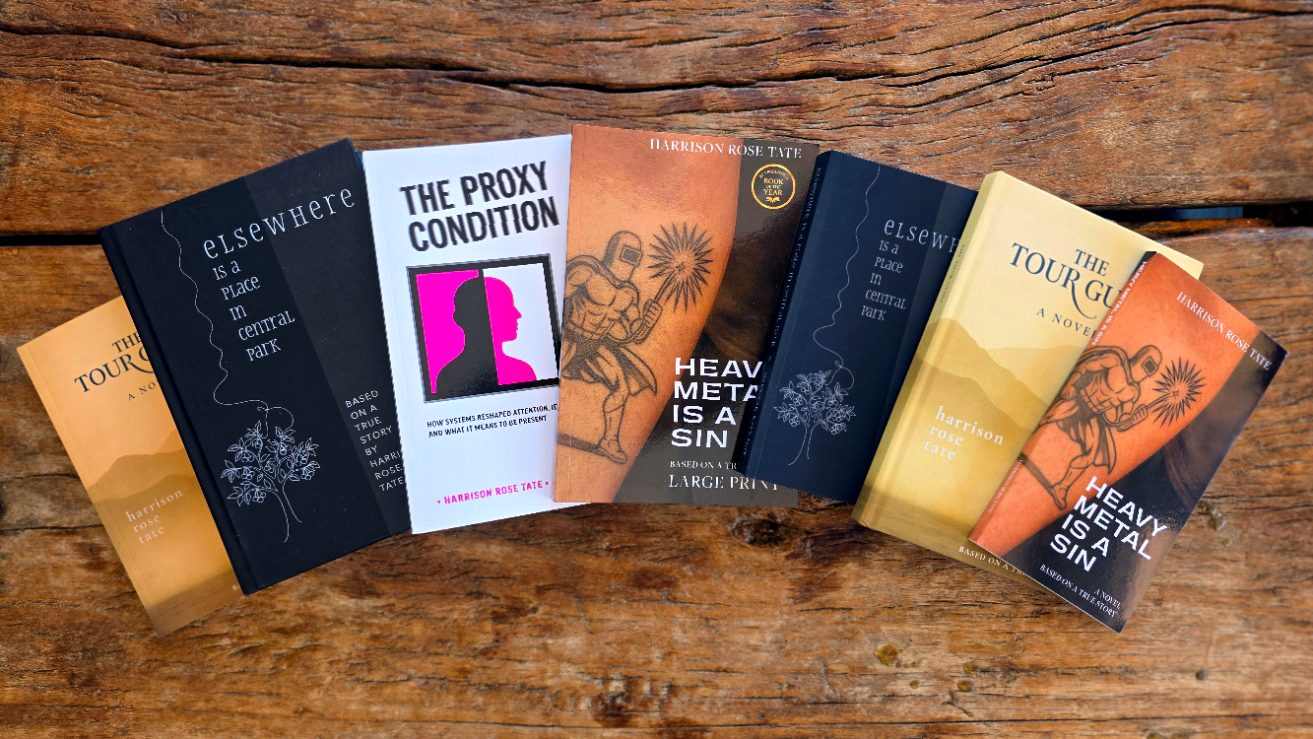
The Proxy Condition examines what happened when digital life became something we no longer simply use, but live within. It looks at attention, identity, presence, and the increasingly blurred line between our physical and digital selves. Existing major works in this genre take an admonishing "less screen time" approach. The Proxy Condition may well be unique. It assumes screen time is inevitable and takes a deep look at how we can interpret, and subsequently manage, our online presence. The proxy us.
Her forthcoming Your Criminal Mind turns to human behavior. Collaborating with Dr. Todd Eisenberg, a practicing psychiatrist, the book examines the changing conditions that affect judgment, inhibition, empathy, morality, and our capacity to act in accordance with what we believe.
The subjects are quite different, but both books question things we tend to assume are settled. They are part philosophy, part science.
Harrison Rose Tate has a goal.
She believes it’s time to return to restrained, classic literature. If you’re tired of the feeling that you’re being told how to react to the story in modern publishing, you’re not alone.
If that describes you, her books are written for you.
Tate teamed up with ECS Publishing. They share a common philosophy: write for cultural permanence, not for a bottom line. Tate does not write for commercial gain. The concept is to consciously avoid trend-chasing or mass appeal and instead create literature that trusts the intelligence and emotional instincts of the reader. Think of their approach as a re-opening of a door some thought had permanently closed in eras past.
Her work spans fiction and nonfiction, but all of it carries the same intent: to preserve what is true, to articulate what has been missed, and to create language for what has not yet been realized. It turns out, there is still a love for this type of literature in the world.
Editorial reviews have been decisively positive, and reader praise has been equally strong. Tate’s reception in the literary world may reflect a broader return to intimate fiction that trusts the reader. Allegory, ambiguity, well-written and thoughtful prose are the tools. A new literary thought space is the goal; to recreate a movement for thoughtful literature that lingers long after the final page.
A systems thinker, technologist, and author, her work explores the intersection of cognition, philosophy, culture, and code. With a professional background in IT leadership, system architecture, and organizational strategy, she brings firsthand insight into the recursive logic of the digital world and its effects on human identity, presence, and autonomy.
Her role over the last two decades as a writer has largely been on behalf of corporations, often without a byline. Her work has appeared in essays, articles, technical publications, and archival formats. Her academic background includes a master’s degree, but most of her insight comes from years spent inside the system; building it, running it, watching how it shapes the people who use it.
After years of ghostwriting, consulting, and building systems for others, her newest titles have special meaning.
They are the first major works published in her own name.
She has lived and traveled extensively throughout the world.
Check social media for upcoming events, library book signings, etc.
Readers, librarians and other professionals: Sourcing information is available here.
Harrison Rose Tate and her team do things differently.
We don’t chase trends.
Operating outside commercial pressures allows Tate to create literature that is raw, moving, and written to stand the test of time.
Tate's titles have been accepted into major institutional collections due to their uniqueness and societal/cultural relevance. Her goal is to create artifacts that preserve what would otherwise have been lost to time.
"The antagonist is often fate, secrets, time,
or what is inside the character that we can't know."